
If you are weighing interlocking garage floor tiles against a bonded garage floor coating for a Fort Myers, Naples, or Port Charlotte garage, the right answer depends on how you use the space and what you want the floor to do long term. Modular tiles give you a removable, replaceable surface with some drainage options, while a professional coating bonds directly to the concrete after the slab is prepared and repaired. Epoxy Floors N More installs garage floor coatings and epoxy flooring systems across Southwest Florida, so this guide focuses on what each option really involves before you decide.
Two Different Products, Not One Category
Interlocking tile is not a single product. Swisstrax, for example, draws a distinction between its perforated Ribtrax tiles and its solid-surface Diamondtrax tiles, and that difference changes how the floor handles liquids and debris (Swisstrax installation and cost FAQs). A perforated tile is built to let spills pass through to channels below, while a solid tile keeps more liquid on the upper surface, although the seams between tiles are not watertight. Before comparing tiles to a coating, it helps to know which type of tile you are actually looking at.
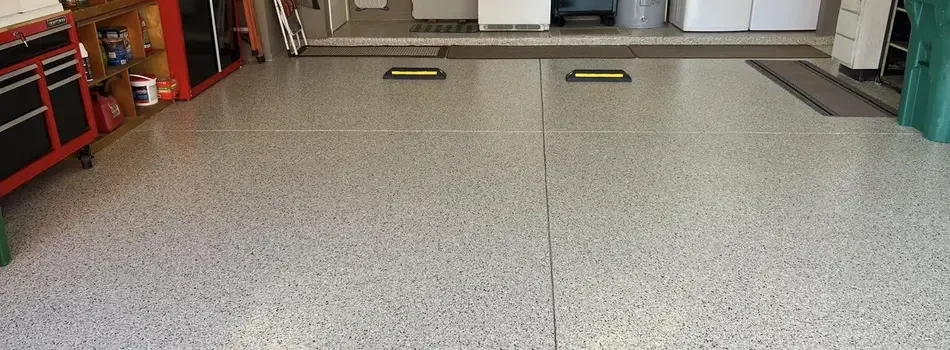
A professional coating is a bonded system rather than individual pieces. Garage floor coatings from Epoxy Floors N More typically start with mechanical grinding of the existing concrete, followed by crack and surface repair, a full flake broadcast, and a clear polyaspartic topcoat. That means the finished floor is one continuous surface rather than a grid of separate panels. For a closer look at how coating systems differ, our comparison of epoxy and polyaspartic garage floor coatings explains the options.

What Actually Happens to Spills and Moisture
Perforated tiles are designed to let liquids and small debris drop through to channels underneath, and most systems let you pop a section up to clean out what collects there, according to Swisstrax. That is a real convenience for oil drips and water tracked in from outside, but it is a different kind of cleanup than wiping a sealed surface. The concrete below the tiles remains exposed to whatever passes through, and trapped moisture or debris may need to be cleaned out periodically.
A bonded coating works the other direction: it creates a continuous protective surface over the concrete, so spills sit on top rather than passing through. That only answers half the moisture question, though. Manufacturer guidance for epoxy systems, including Sika's documentation for its Sikafloor line, calls for checking concrete moisture, ambient humidity, surface temperature, and dew point before application (Sika Sikafloor-264 product data sheet). A coating does not automatically resolve moisture vapor coming up through a slab, and the prep work underneath matters as much as the topcoat on top.
Installation, Expansion, and Getting Back to Using Your Garage
Modular tile installation generally involves measuring the space, trimming tiles to fit around obstacles, and adding ramp edges where the floor meets a doorway or step. Because tiles are rigid interlocking pieces, installers also need to leave clearance around walls and fixed objects. RaceDeck's own installation instructions call for roughly a quarter inch to a half inch of expansion gap to accommodate expansion and contraction as temperatures change (RaceDeck garage flooring installation guide). Skip that clearance and a tile floor can bind up against the walls over time.
A coating has a different timeline. Manufacturer data sheets distinguish between when a finished coating can handle foot traffic, when it can take light traffic, and when it reaches a full cure, with each stage taking longer in cooler temperatures. A finished-looking floor is not automatically ready for a vehicle, so the actual return-to-use schedule should come from whoever installed the system rather than a general rule of thumb.
Comparing the Real Cost of Each Project
Price comparisons between tiles and coatings are only fair when you compare complete projects, not just material cost. A box of tiles can look inexpensive next to a coating quote until you add in trimming, ramp edges, and installation labor. On the coating side, Epoxy Floors N More's published polyaspartic coating cost guide lists a full polyaspartic system at roughly $7 to $12 per square foot, which works out to about $3,000 to $6,000 for most standard two-car garages, depending on the condition of the slab and the repair scope needed. These figures are published examples rather than a quote for your specific garage.
Making the Call for Your Garage
| Factor | Interlocking Tiles | Garage Floor Coating |
|---|---|---|
| Surface type | Individual panels, removable for cleaning or replacement | One continuous bonded surface |
| Spill handling | Perforated designs let liquid pass through to channels below; solid designs retain more liquid on top | Creates a protective surface over the concrete; depends on proper moisture assessment underneath |
| Installation considerations | Needs trimming, ramp edges, and expansion clearance around walls | Needs grinding, crack repair, and a set cure schedule before full use |
| Typical SWFL cost example | Varies by product and installation labor | Roughly $7 to $12 per square foot ($3,000 to $6,000 for most two-car garages) for a full polyaspartic system |
If you want a floor you can remove, replace a damaged section of, or take with you if you move, tiles are worth a closer look, provided you choose a design suited to how much liquid or debris your garage actually sees. If you want one continuous protective surface with a documented repair and application process, a coating like the garage floor coatings and epoxy flooring systems installed by Epoxy Floors N More across Fort Myers, Naples, and Port Charlotte is the more direct route. Either way, this comes down to what fits your garage, not a universal right answer.
Ready to Talk Through Your Garage Floor Options?
Epoxy Floors N More installs garage floor coatings and epoxy flooring systems for homeowners throughout Fort Myers, Naples, and Port Charlotte. Qualifying residential garage flake floors are backed by a lifetime warranty, with specific coverage and terms outlined in the company's written agreement. If you would like help deciding what makes sense for your garage, call us at (239) 339-7238 to talk through your space and get your questions answered.
Written by
Timothy Gonzalez
Epoxy Floors N More shares practical guidance based on floor coating work across Southwest Florida.