
Garage floor paint vs epoxy comes down to durability and long-term value. Paint runs $0.80–$2.50 per square foot but typically peels within two to three years in Southwest Florida’s heat and humidity. Professional epoxy costs $4–$10 per square foot and is designed to last 10–15 years with proper surface preparation.
Most homeowners weighing these two options have already watched a painted floor bubble or flake after a single summer. The decision sounds straightforward—paint is cheap, epoxy is expensive—but the actual math changes when you factor in repainting every two to three years versus one installation that outlasts your next vehicle.
Epoxy Floors N More has watched the same paint-vs-epoxy decision play out across hundreds of Lee and Collier County garages. Below, we explain why paint fails in this climate, what a professional epoxy system does differently, and how the cost comparison pans out over five years.
Why Paint Fails in Southwest Florida Garages

Latex and epoxy paint products sold at hardware stores form a thin film that sits on top of concrete without creating a mechanical bond. In Southwest Florida, that’s a critical weakness.
Heat and UV Exposure
Concrete surfaces inside open or semi-enclosed garages in Fort Myers and Cape Coral regularly exceed 130°F during summer months. That heat softens paint films and accelerates peeling. UV radiation breaks down the resin binders in paint within 12–18 months, leaving a chalky, flaking surface.
Hot Tire Pickup
When you park after driving on Florida’s sun-heated roads, your tires transfer heat directly to the floor surface. Paint doesn’t have the adhesion strength to resist this thermal cycling, so it lifts off in sheets wherever tires sit consistently.
What Professional Epoxy Does Differently
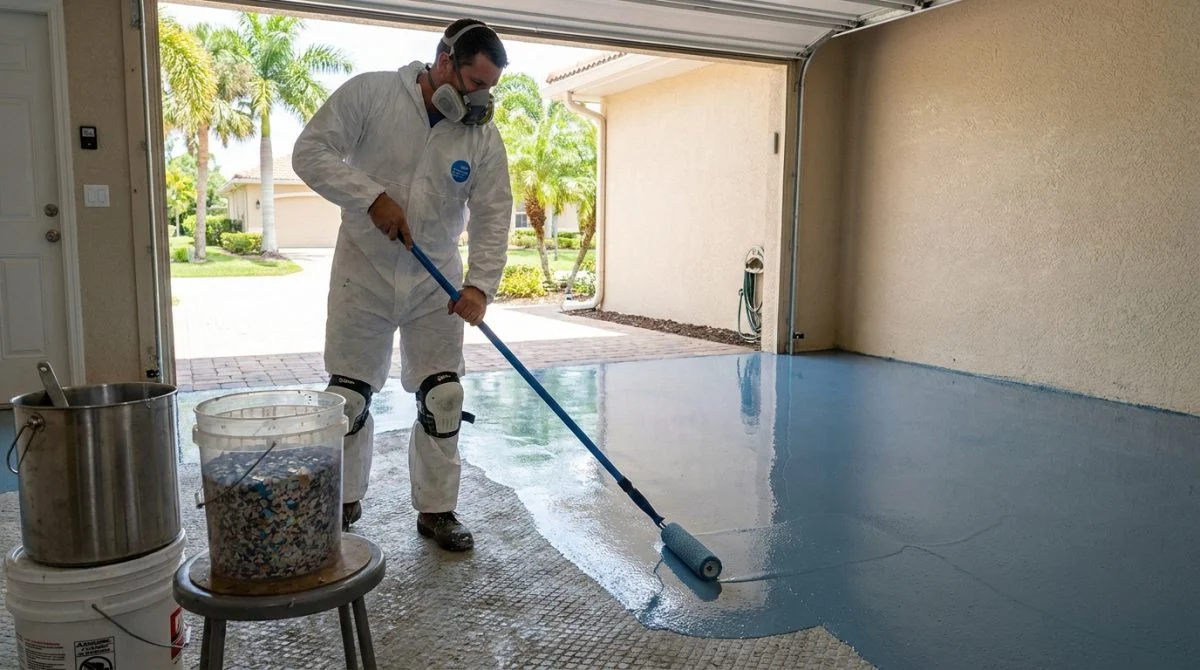
A professional epoxy system bonds to concrete at the molecular level after diamond grinding opens the pore structure of the slab. That mechanical profile gives the coating something to grip that paint typically cannot achieve.
- Base coat penetrates prepared concrete and forms a permanent chemical bond
- Broadcast layer (decorative flake, quartz, or metallic pigment) adds thickness and slip resistance
- UV-stable topcoat seals everything and provides chemical, abrasion, and stain resistance
The result handles oil drips, salt tracked in from coastal roads near Bonita Springs and Naples, and years of hot tire contact without lifting. This multi-layer approach is why professional garage floor coatings outlast paint by a factor of five or more.
Five-Year Cost Comparison
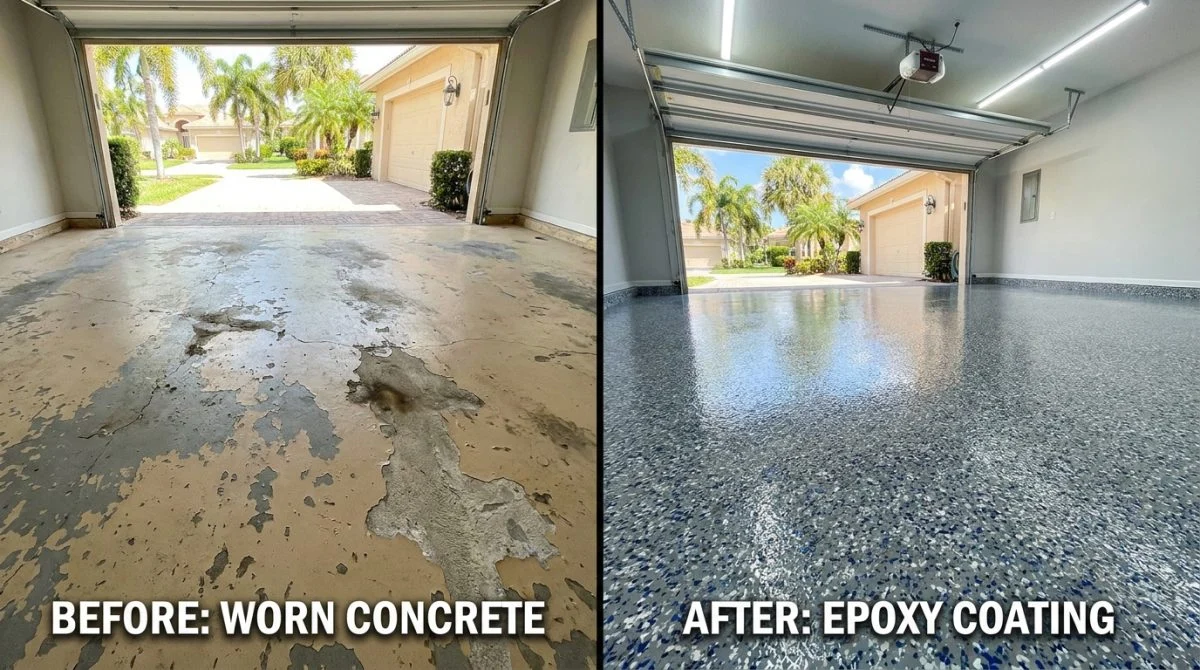
Upfront price tells one story. Total cost over five years tells a different one entirely.
Paint
- Initial cost: $200–$400 in materials for a standard two-car garage
- Reapplication needed every 2–3 years in Southwest Florida conditions
- Five-year total: $600–$1,200 in materials alone, plus repeated prep time and garage downtime
Professional Epoxy
- Initial cost: $2,000–$3,000 installed for a standard two-car garage
- Typically no reapplication needed within 10–15 years
- Five-year total: $2,000–$3,000 with zero maintenance costs beyond routine cleaning
By year four, a homeowner who painted twice still has a floor that needs recoating, while the homeowner who chose epoxy is roughly halfway through a coating that won’t need attention for another decade. Understanding what causes floor coating failure helps explain why the performance gap widens every year in this climate.
Frequently Asked Questions
Can I apply epoxy over existing garage floor paint?
No. Paint must be fully removed before epoxy installation because the coating needs direct contact with bare, profiled concrete to form its bond. Epoxy Floors N More grinds the surface to remove old coatings and open the concrete’s pore structure during preparation.
How long does a professional epoxy garage floor take to install?
Most residential garage floors take one to two days depending on the coating system and garage size. Polyaspartic systems cure faster and allow light foot traffic within 24 hours, making them popular for Southwest Florida homeowners who want minimal downtime.
Does professional epoxy resist hot tire marks in Florida heat?
A properly installed multi-layer system with a UV-stable polyaspartic or polyurea topcoat resists hot tire pickup. The topcoat’s thermal stability prevents the surface-softening that causes paint to lift under repeated tire heat cycling.
Choose the Coating That Can Handle Florida’s Worst

Paint saves money on day one. Epoxy saves money by year four and still looks clean a decade later. For Southwest Florida homeowners dealing with UV, humidity, salt air, and daily heat cycling, the real question is whether you can afford to keep repainting every two to three years.
Contact Epoxy Floors N More at (239) 339-7238 or request a free estimate to see what a professional coating system costs for your garage.
Written by
Timothy Gonzalez
Epoxy Floors N More shares practical guidance based on floor coating work across Southwest Florida.