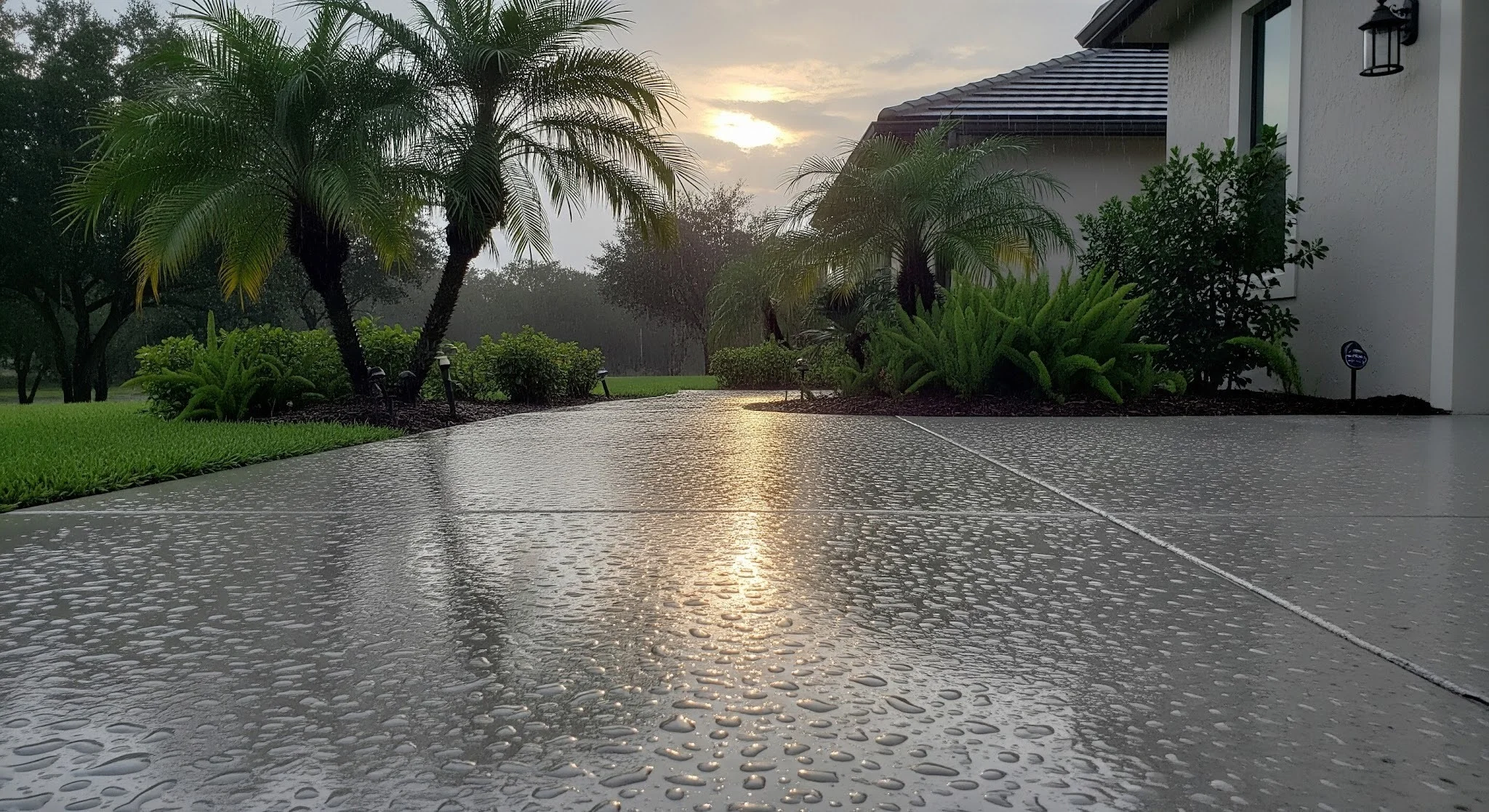
The best concrete sealer for Florida patios and driveways depends on the surface’s condition, exposure level, and whether you need protection, appearance enhancement, or both. Penetrating sealers, acrylic sealers, polyurethane sealers, and epoxy sealers each handle Southwest Florida’s UV, heat, and moisture differently. Epoxy Floors N More provides concrete sealing for homeowners across Fort Myers, Cape Coral, Naples, and Southwest Florida.
Florida’s rainy season starts in late May and runs through October. Before it arrives, every unprotected concrete patio, driveway, and walkway in Southwest Florida is absorbing moisture, collecting organic growth, and quietly degrading from the relentless UV exposure. Sealing before the wet season is one of the most effective steps a homeowner can take to extend the life of outdoor concrete. Waiting until fall means the damage from another rainy season is already done.
Penetrating Sealers: Best for Long-Term Protection Without Changing the Look
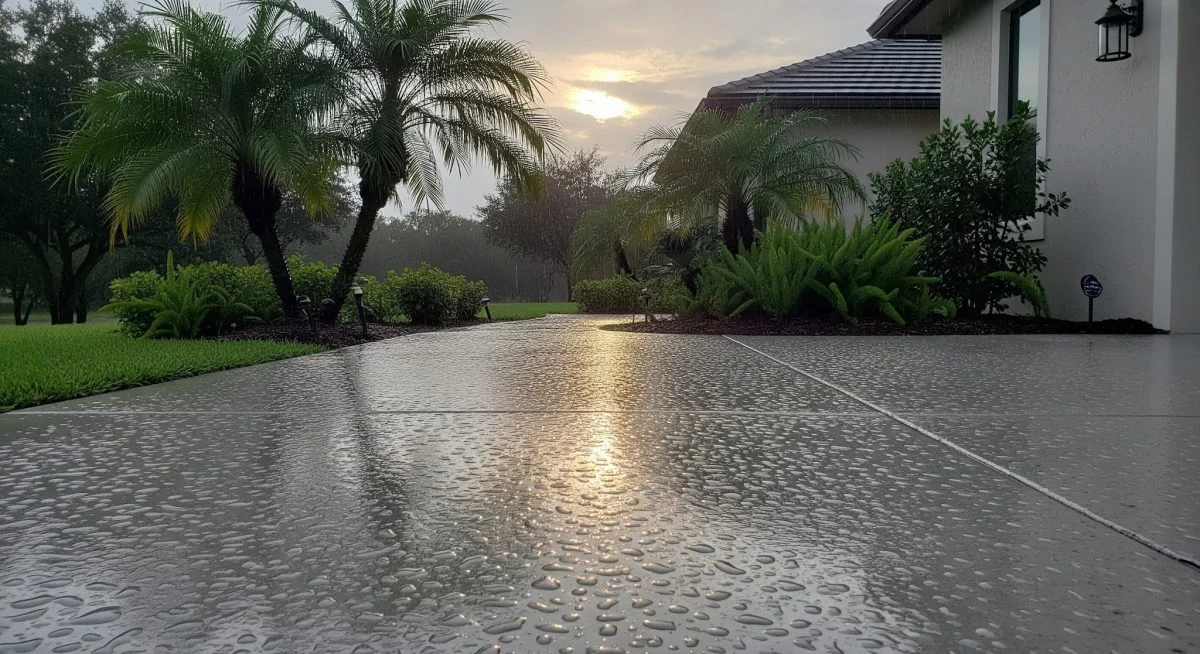
Penetrating sealers (silane, siloxane, or silicate-based) are absorbed by the concrete and create a chemical barrier within the pores. They don’t form a film on the surface, which means the concrete’s natural appearance stays the same.
In Southwest Florida, penetrating sealers protect against moisture intrusion, chloride damage from salt air in coastal communities like Bonita Springs and Naples, and the sustained moisture that degrades concrete in our region. They’re the best option for homeowners who want protection without changing how their concrete looks.
Penetrating sealers generally carry manufacturer ratings of three to seven years before reapplication, depending on traffic and UV exposure. They don’t add gloss, color, or texture.
Acrylic Sealers: Color Enhancement With Regular Maintenance
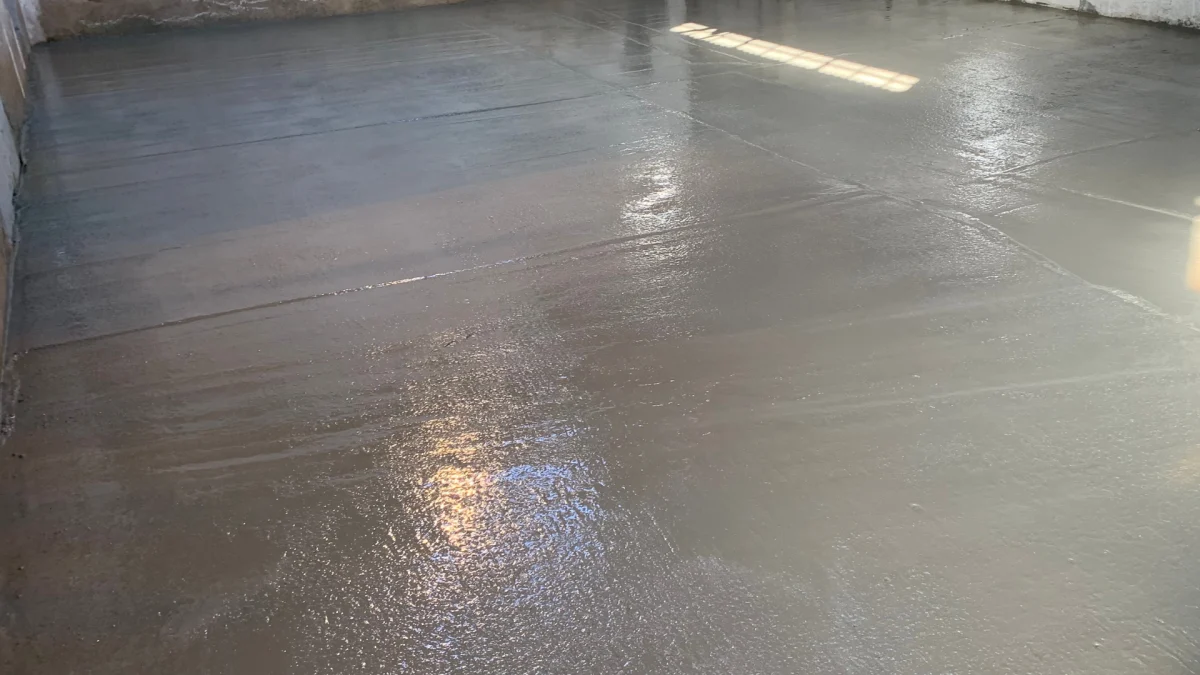
Acrylic sealers form a thin film on the concrete surface that enhances color, adds a mild to high sheen, and provides basic UV protection. They’re popular for stained concrete, decorative finishes, and patios where the homeowner wants the concrete’s color to pop.
The trade-off in Southwest Florida is how often they need to be reapplied. Acrylic sealers wear faster under this region’s UV and moisture conditions than in cooler climates. Most manufacturers recommend resealing every one to three years on surfaces with direct sun exposure. For homeowners willing to maintain that schedule, acrylics offer good visual results at a reasonable cost.
Polyurethane Sealers: Highest Durability for High-Traffic Surfaces
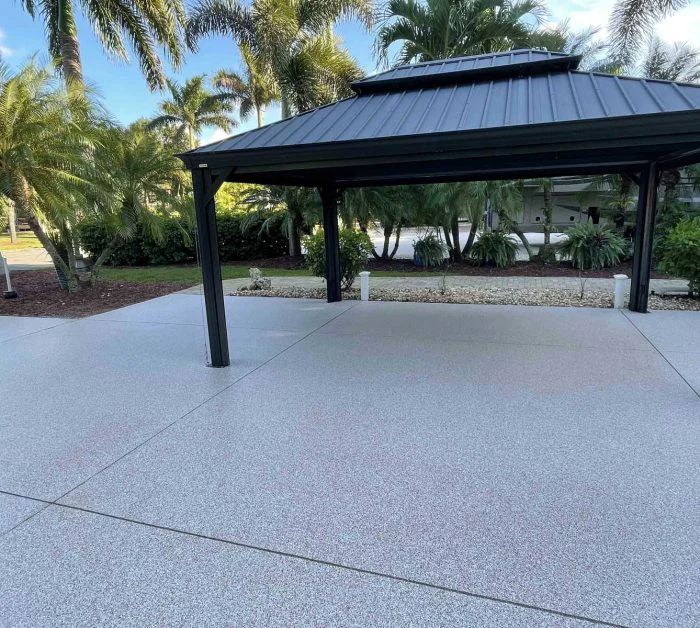
Polyurethane sealers create a harder, more abrasion-resistant film than acrylics. They handle foot traffic, vehicle traffic, and chemical exposure better than any other topical sealer. UV-stable formulations (aliphatic polyurethane) resist yellowing under Florida sun.
For driveways and high-traffic patios in Fort Myers and the surrounding area, polyurethane is the strongest topical sealer. It costs more per square foot than acrylic but lasts two to three times longer between applications. Achieving the right concrete surface profile (CSP) before sealing is critical for creating the proper anchor profile for a durable, long-lasting bond.
Epoxy Sealers: Indoor and Garage Applications
Epoxy sealers create a thick, high-gloss surface with strong chemical resistance. They work well on garage floors and interior concrete where UV exposure is minimal. For outdoor patios and driveways in Southwest Florida, standard epoxy sealers yellow under sun exposure and are not the right choice.
UV-stable epoxy formulations exist but cost significantly more than polyurethane alternatives that deliver comparable outdoor performance. For most outdoor surfaces, polyurethane or penetrating sealers are the better fit. Epoxy sealers remain the standard for enclosed garage floor applications where UV isn’t a factor.
How To Choose the Right Sealer for Your Surface

The decision depends on three factors: what you want the sealer to do, how much maintenance you’re willing to perform, and what the surface is exposed to.
- For protection without changing the look: penetrating sealer
- For color enhancement on decorative concrete: acrylic sealer
- For maximum durability on driveways and high-traffic patios: polyurethane sealer
- For garage floors and indoor concrete: epoxy sealer
Every option performs better when applied over properly prepared concrete. Surface cleaning, crack repair, and moisture assessment before sealing are what determine whether the sealer bonds properly and lasts to its full potential.
Frequently Asked Questions
How often should I reseal my concrete patio or driveway in Florida?
Resealing frequency depends on the sealer type and UV exposure. Penetrating sealers last three to seven years. Acrylic sealers need reapplication every one to three years on sun-exposed surfaces. Polyurethane sealers last three to five years. Traffic volume, direct sun exposure, and proximity to salt air all affect the timeline.
Can I seal concrete that already has a coating or sealer on it?
It depends on the existing treatment. A new sealer can sometimes go over an existing compatible sealer after cleaning and light prep. If the existing treatment is peeling or incompatible, it needs to be removed first. Epoxy Floors N More evaluates the surface condition during the free consultation to determine the right approach.
What is the best concrete sealer for pool decks in Fort Myers?
For pool decks in Fort Myers and Southwest Florida, a non-slip acrylic or polyurethane sealer with anti-slip aggregate provides the best combination of traction, UV protection, and moisture resistance. The sealer must handle chlorinated splash water, direct sun, and wet-surface safety requirements. Epoxy Floors N More installs pool deck sealers across Fort Myers and the surrounding communities.
Have Your Concrete Sealed Before the Rainy Season
The best time to seal outdoor concrete in Southwest Florida is before the wet season compounds existing damage. For protection without changing the look, a penetrating sealer is the safest choice. For enhanced color or maximum durability, acrylic or polyurethane sealers deliver stronger results on high-traffic and sun-exposed surfaces.
DIY sealing has its limits in Florida humidity. You can also have our Fort Myers crew handle the sealing for a longer-lasting result — we use solvent-borne acrylics that handle UV better than the box-store options.
A properly sealed patio or driveway handles everything from May through October better than bare concrete. Get a free quote from Epoxy Floors N More by visiting our contact page or calling (239) 339-7238. Let us help you identify the right sealer for your surface.
Written by
Timothy Gonzalez
Epoxy Floors N More shares practical guidance based on floor coating work across Southwest Florida.